in partnership with

“It is time to replace the national flags flying over the bases in Antarctica with a common emblem,”
Aant Eltzinga, former professor at the University of Gothenburg, Sweden.
The think tank Le Cercle Polaire invited the Penninghen school to design an emblem for Antarctica. This was introduced by a series of lectures presenting the history and challenges of Antarctica, a continent covered in ice, surrounded by ocean, and belonging to no one. “Our common home,” said former UN Secretary-General Ban Ki-moon, hence the resulting initiative to propose the collaborative creation of a flag for this vast territory with a unique legal status managed by the international community.
In a diplomatic context bringing together 58 states, the creation of this emblem is the first part of an educational and political initiative aimed at the younger generation. On the initiative of the Le Cercle Polaire association and the Penninghen school, the initiative may be taken up successively by other higher education institutions in the member countries of the Cumulus network, thus giving substance to the ideal of international recognition of this “land of peace and science.”
The South Pole is an area dedicated to scientific research and a privileged space for international cooperation. As a demilitarized zone, Antarctica is also exempt from any territorial appropriation, even though seven countries, including France, claim a portion of this territory. Numerous scientific stations are located there, flying the national emblems of the various countries present.
Under the influence of climate change, the evolution of the energy situation, and the emergence of a new multipolar world order, the high latitudes, some of the most unspoiled natural areas on our planet, are the subject of increasingly strategic positioning on the part of certain powers. As an internationalized area, it is surprising that the international community has never taken the initiative to adopt a universal emblem to affirm this supranational dimension beyond the multiplicity of national emblems.
Developing an emblem for Antarctica represents a real challenge and a powerful political symbol in the current era. It reflects a desire to give the planet a unified and universal graphic expression, beyond national self-interest.
The sixth continent is the manifestation of what does not belong to us, while reflecting our past, present, and future actions. As French explorer Jean-Louis Etienne so aptly put it: “Antarctica is not a continent for man. It is a continent for Nature.”
Gilles Poplin, Director of the Penninghen School, and Laurent Mayet, President of the Cercle Polaire
INTERNATIONAL CONTEXT
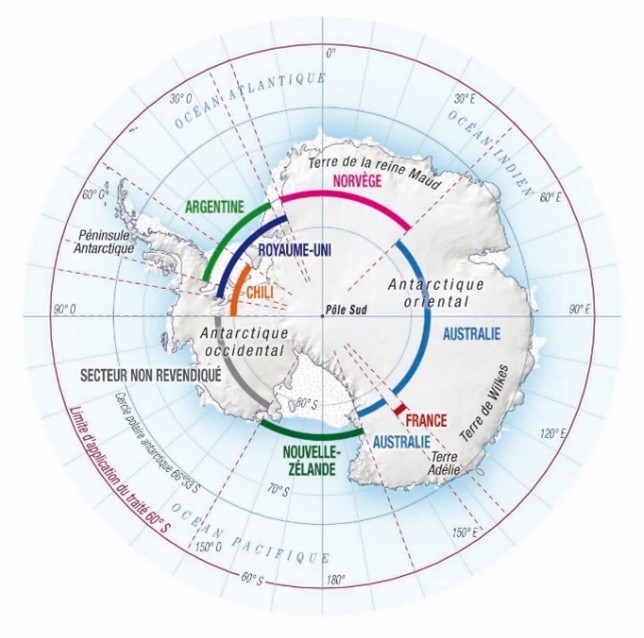
Antarctica, the last unspoiled land and sea on our planet, benefits from a unique international legal regime (the Antarctic Treaty System or “ATS”) that exempts it from any national appropriation and protects it from mining. Historically claimed by seven so-called “possessing” states, the 1959 Antarctic Treaty froze these territorial claims in favor of international governance. The Madrid Protocol, signed in 1991, declares the Antarctic Treaty area (beyond 60° South latitude) a “natural reserve dedicated to science and peace
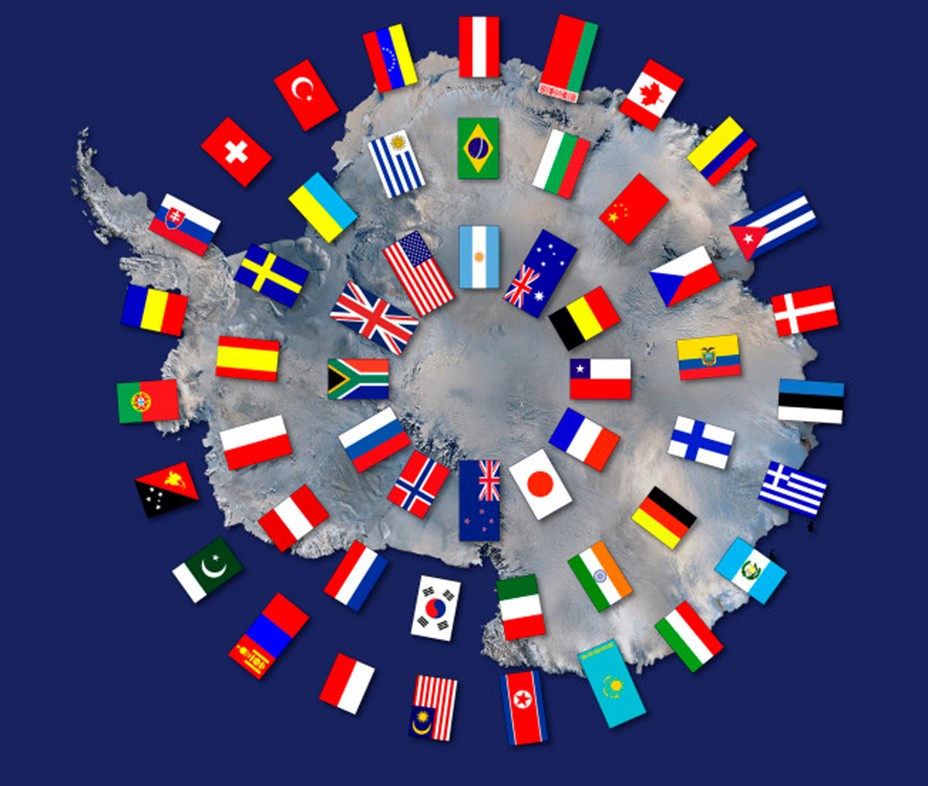
This vast natural area is jointly managed by (to date) 58 states, and the Antarctic Treaty remains open to all interested states. As an internationalized zone, Antarctica belongs to no one, and it is surprising that the international community has never taken the initiative to give Antarctica a universal emblem to affirm this supranational dimension beyond the multiplicity of national emblems. As the Swedish philosopher Aant Eltzinga, professor at the University of Gothenburg, stated a few years ago: “It is time to replace the national flags flying over the bases in Antarctica with a common emblem. “
AN EMBLEM FOR THE ANTARCTIC TREATY
Failing to overcome latent or overt nationalism in Antarctica and assert the international dimension of the Antarctic region, the Parties to the Antarctic Treaty have fallen back on the diplomatically neutral solution of an emblem for the international organization of the Antarctic Treaty, or more precisely, an emblem for the permanent secretariat of the Antarctic Treaty, based in Buenos Aires, Argentina.
The use of this flag is the result of Article 7 of the headquarters agreement negotiated with Argentina. The flag is derived from the STA emblem adopted in Warsaw (25th RCTA, September 10-20, 2002) on the initiative of the United Kingdom, on which occasion a flag was officially adopted as the “formal emblem of the Antarctic Treaty” (Decision 2, 2002). This flag shows a map of the Antarctic continent in white on a navy blue background (RGB: 000-051-102. CMYK: 100-56-0-34. Pantone 295C) with the main latitude and longitude lines superimposed.
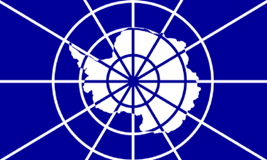
Source : https://fr.no1flag.com/info/antarctic-treaty-flag-20747011.html
Some argue that this emblem is now recognized as an emblem of Antarctica and not just of the treaty organization, but this statement poorly conceals the difficulty that the international community of States Parties to the Antarctic Treaty has in sharing a common and unambiguous interpretation of the international dimension of the Antarctic Treaty area. It must be said that Article IV of the Antarctic Treaty enshrines an ambiguity or ambivalence:
“Nothing in this Treaty shall be construed: […] as affecting the position of any Contracting Party with respect to the recognition or non-recognition by that Party of the sovereignty rights, claims or bases of claims of any other State in Antarctica “ (Antarctic Treaty, Article IV, 1.c)
OBJECTIVES OF THE ”AN EMBLEM FOR ANTARCTICA” PROGRAM
- Create the terms and conditions for developing an emblem for Antarctica
- Give the initiative a title
- Develop a symbol for Antarctica that transcends the cultural and linguistic particularities of the 58 Parties to the Antarctic Treaty, in order to achieve a representation with global or universal significance.
- Write a manifesto based on the study in support of this vision of Antarctica, “our common heritage.”
- Write a press release (argument).
- Develop scenarios for communication and handover (public opinion, NGOs, administrations, diplomats, delegates to the annual meetings of the Antarctic Treaty).
SCHEDULE
Series of lectures from January 21 to February 11 (open to all Master’s 2 students).
Creation is a language of which we are the interpreters. To enlighten students and give the project its full scope and legitimacy, a series of lectures is being organized, bringing together different points of view from stakeholders. Bringing together divergent points of view.
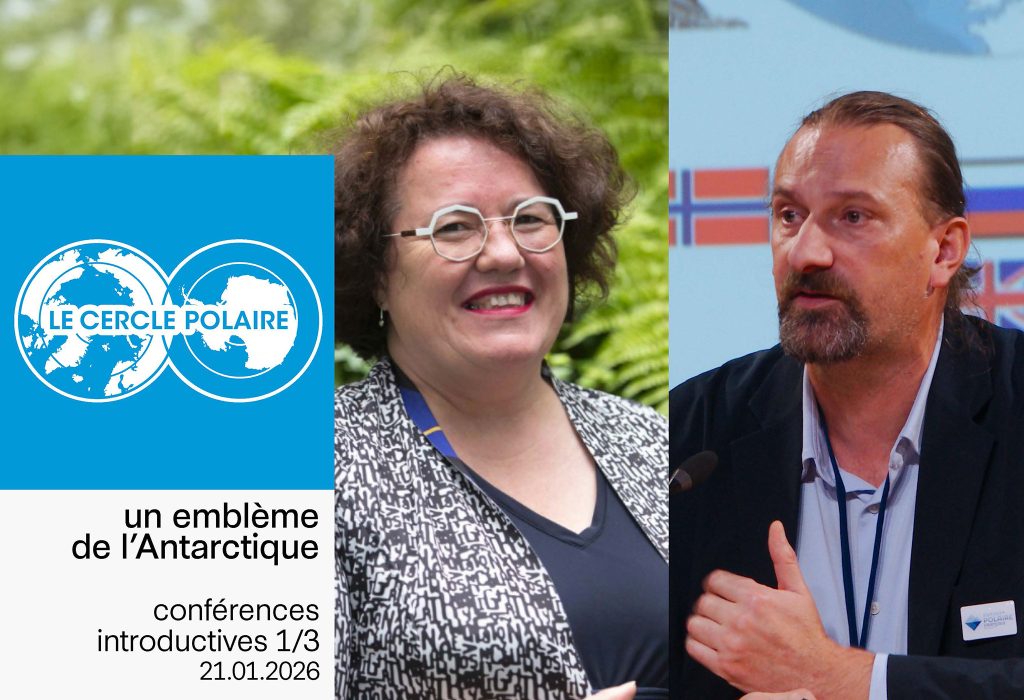
“Antarctica, a utopia realized” by Anne Choquet, legal researcher at the European Institute for Marine Studies
“Science at the heart of the polar ideal” by Yan Ropert-Coudert, research director at the CNRS, former director of the French Polar Institute

“Crossing Antarctica solo and in full” by Laurence de la Ferrière, the first French person to have crossed the geographic South Pole solo and the first woman to have crossed Antarctica in full and solo
“A space dedicated to Nature and Peace. Yes, but for how long?” by Laurent Mayet, former Special Representative for Polar Affairs at the Ministry of Foreign Affairs, Ministerial Representative for Polar Issues at the Ministry of National Education.

“From Antarctica to outer space” by Thomas Leclerc, Senior Lecturer in Public Law at the University of Western Brittany
“Saving Antarctica” Ricardo Roura, Senior Campaigner, Antarctic Southern Oscillation Coalition (ASOC)
Workshop from February 23 to 27, 2026, from 10 a.m. to 1 p.m. and from 2 p.m. to 5 p.m.
Design of the emblem and communication elements
Presentation March 11, 2026